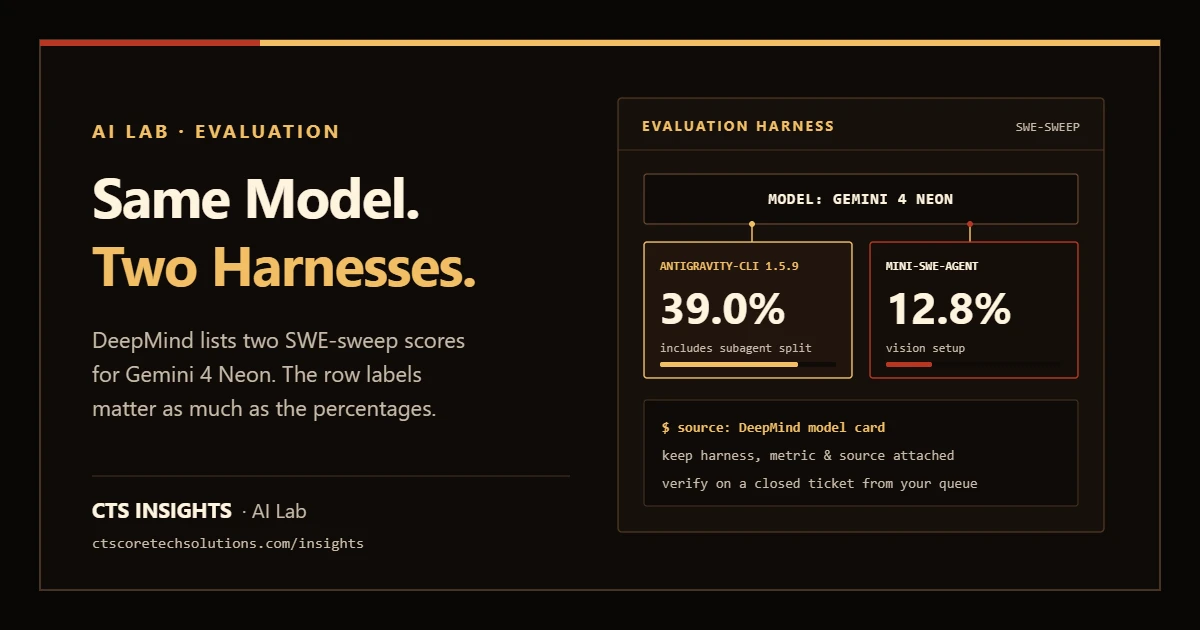
Google DeepMind reports 39.0% and 12.8% for Gemini 4 Neon on SWE-sweep. Both entries appear in the same model card, under the same model name. If you’re deciding what to try on a stubborn software bug, the row labels matter as much as the numbers. Gemini 4 Neon model card, Evaluation
What changed between the rows?
A harness is the software that lets the model act on a task and use tools. For the 39.0% result, DeepMind ran Neon in Antigravity-CLI 1.5.9. That setup includes a tool that can split work among agents. For the 12.8% result, DeepMind used its mini-SWE-agent vision setup. DeepMind computed both results and describes the SWE-sweep metric as a reward weighted by subtask. Evaluation PDF, Agentic Coding, p. 2 as printed
That leaves a practical question open. How much of the difference came from splitting up the work? The methods describe two setups. Isolating the effect of that one tool would take a comparison that held the rest of the setup fixed.
What to write beside the number
For a team deciding whether to try Neon, a useful note would read: “DeepMind reported 39.0% on SWE-sweep using Neon with Antigravity-CLI 1.5.9.” Keep the metric and source attached. Turning that figure into a prediction about how many of your team’s bug tickets will close would take evidence from your own queue.
For a trial, pick a closed ticket whose correct behavior is easy to check. Decide up front whether the model gets the original bug report. Record the tools you give it and the test a proposed fix has to pass. That gives the next person enough context to interpret the result.